
Inside Atchison County Property Tax Records
Atchison County property tax records split cleanly in two. The Appraiser public portal holds the parcel card and its valuation components, while the Treasurer tax search holds the account, year, current taxes and history. Grab the CAMA number from the first result. That number lets you match the same land across both systems without guessing.
| Field | What It Shows | Where |
|---|---|---|
| Land, building and total appraised value | Separate valuation components for a tax year | Appraiser parcel card |
| Property class and taxing unit | The classification and local tax-unit assignment | Appraiser parcel card |
| CAMA and tax identification | Keys that bridge appraisal, tax and GIS results | Both county systems |
| Current taxes and tax history | Amounts shown for the selected account and year | Treasurer results |
| Owner/taxpayer and addresses | Current name match plus situs and mailing data | Treasurer and Appraiser |
Appraised total is not assessed value, and neither is a recorded sale price. Kansas applies a statutory assessment percentage to the appraised figure. Local mill levies then tax the result. The transfer trail runs through the deed and the Sales Validation Questionnaire. The parcel card itself displays no last-sale price field.
Appraised, Assessed and Taxable in Atchison County
Atchison County property gets a fresh valuation each year, pegged to January 1 under Kansas law. Most real estate is appraised at fair market value. Farmland works differently. Its value rests on use and productivity rather than what a developer might pay. Once the appraiser settles a value, an assessment percentage converts it into a taxable figure. The rates come from K.S.A. 79-1439. Residential property is assessed at 11.5%, agricultural land at 30%, and vacant lots at 12%. Commercial and industrial property carries 25%. Public utilities sit at 33%, and other property rounds out the schedule at 30%. Knowing these percentages makes a tax roll entry much easier to read.
- Appraised value
- The Appraiser’s estimate before applying the statutory class percentage.
- Assessed value
- Appraised value multiplied by the percentage assigned to the property class.
- Mill levy
- The rate applied to assessed value; assessed value times mills divided by 1,000 produces tax before relevant adjustments.
- Tax lien
- A claim arising from unpaid taxes; it should be checked separately from title and deed ownership.
The Kansas Department of Revenue formula ties the property record card to the tax bill in one clean step. One caution for Atchison County farmland owners. Use the agricultural-use figure, not ordinary market-land value, when working the assessment math on a parcel.
What Atchison County’s 2026 Cards Reveal
A residential sample at 1124 S. 4th Street breaks into $5,800 land, $152,060 building and $157,860 total appraised value. Its card also lists class Residential-R, neighborhood 112.C Atchison and taxing unit 001. A second residential parcel is owned by an LLC. That entity ownership alone does not change the residential classification.
The farm example teaches more. One card separates a farm-homesite total from $3,200 in agricultural-use land value. It also shows $93,610 in market land across 19.61 acres. Those lines answer different questions. The tax calculation needs the classified or use value. A market discussion may weigh other figures and appraisal methods.
The sample Appraiser card shows how the county presents these components.
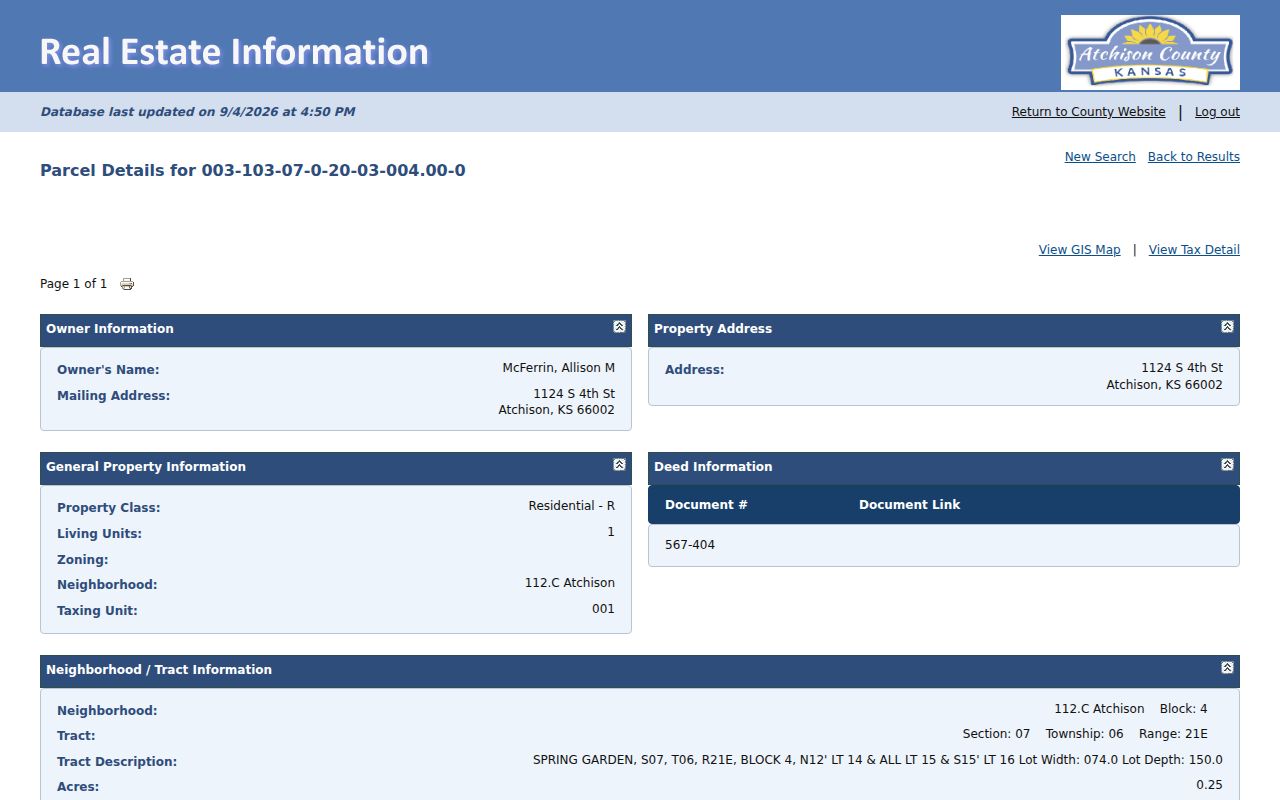
Read the land, building, total, class and taxing-unit fields as one dated valuation snapshot. None of them is a present-day sale-price estimate.
Note: Keep the tax year with every copied value; the county values property annually and later cards can differ.
Search Fields in the Atchison County Treasurer Portal
Every Treasurer search starts with a tax type. Real Estate (RL) is only one of seven choices. Personal Property, Oil, Gas, Trucks, Minerals and State Assessed Utilities carry their own codes. A rural owner who limits a search to RL may therefore miss another account tied to the same name.
| Search route | Documented fields | Best use |
|---|---|---|
| Parcel/account | CAMA components, tax ID, tax year | Exact known account |
| Name | Name; Current Owner, Taxpayer or Both | Resolve who is tied to the tax statement |
| Street | Number, name, direction and ZIP | Known situs address |
| Platted land | Subdivision, block and lot | City addition or plat search |
| Rural/legal location | Section, township, range, lease and quick reference | Farm, mineral or legal-location research |
The official Atchison County tax-search form shows these routes in one interface.
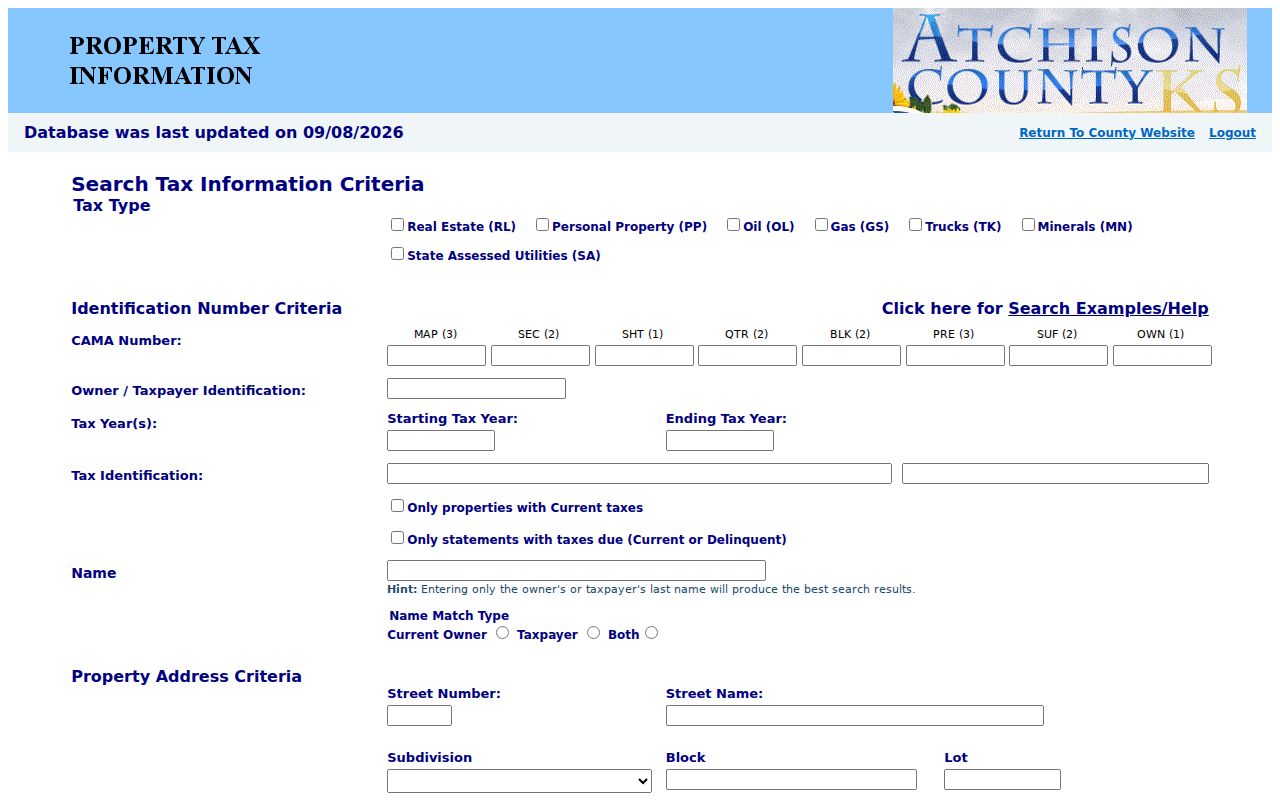
That structure is why copying the full CAMA and noting the tax type beats relying on a broad surname. Common last names pull in unrelated accounts across several tax types.
Look Up an Atchison County Tax Bill
Carry the same parcel key through appraisal and tax records alike. That discipline keeps similarly named owners and nearby lots from getting mixed together.
- Open the Appraiser card by exact address and copy the CAMA number, property class, taxing unit and legal description.
- Choose the correct tax type and year in the Treasurer portal; search CAMA or tax ID before falling back to owner or street.
- Open Current Taxes, Tax History and Current Real Estate Detail, recording the search date and checked filters.
- Compare land, building and total appraisal lines with the tax account, then investigate delinquency or sale status in its separate source.
The Treasurer page carries a database timestamp. It shows when the portal was last refreshed, not a promise that every payment or filing appears instantly.
From Atchison County Delinquency to Tax Sale
A checked "taxes due" filter helps narrow a search. It is not the complete legal status of a parcel. Weigh current taxes against the county Tax Sale page. Weigh history against court filings and the Sheriff's sale notices. Special assessments, nuisance liens and mortgage foreclosure records can sit with different custodians. They can also arrive on different dates.
Tax-sale caution. The county’s 2025 instructions say the legal description controls, the county gives no title warranty and a buyer takes substantial risk.
Bidders must follow the current instructions, registration and payment terms. An old list or a common street address controls nothing. A paid tax account, likewise, does not establish marketable title.
The Atchison County Property Tax Calendar
| Date or period | County tax event |
|---|---|
| January 1 | Appraiser values taxable and exempt real and personal property. |
| March 1 | Real-property classification and value notice. |
| 30 days after mailing | Deadline to appeal a real-property classification or value notice. |
| May 15 | Personal-property appeal deadline. |
| December 20 | First-half or full tax due; ordinary payment-under-protest date. |
| May 10 following year | Second-half tax due. |
Check the current Property Tax Calendar for the year in question. An escrow company may pay before December 20. The protest deadline then lands on January 31 of the following year.
Classification dates and payment dates answer different questions. The March notice opens the value challenge; the December and May dates govern installments. Wait for the bill and you can forfeit the ordinary valuation appeal. Payment months may still lie ahead. Note the notice mailing date rather than assuming the published calendar supplies the parcel's exact deadline.
Reach Atchison County Tax Records Beyond the Search Screen
Online portals move fastest. They are not the only route. When an account refuses to resolve on screen, carry the CAMA number, tax year, owner spelling and legal description straight to the office that holds the answer. The County Appraiser can produce the valuation card. The Treasurer keeps the full tax-account history. A narrow Kansas Open Records Act request works too, asking an existing custodian for an existing record in paper or electronic form; name the parcel, the custodian, the date span and the format rather than asking the county to build a new analysis.
Match the request to the record. Assessment files may hold a property record card, comparable-sales report, photographs, sketches or valuation worksheets. Payment questions call for a specific year's statement, receipt or history. Delinquent and tax-sale materials should be requested by legal description plus case or publication date, since those records often sit outside the ordinary current-tax result.
Keep each office's answer distinct. The Appraiser sets classification and value. The Treasurer bills and collects. The Register of Deeds holds conveyances and recorded liens, and a court file may control a tax-sale confirmation. Weaving them into one chronology helps, but no office's output should be labeled as another's certified record. Note the tax year and search date on everything, because a portal result can shift after a payment, correction, appeal decision or annual valuation update.
Challenge an Atchison County Assessment
An appeal starts with the valuation notice. Do not wait for the bill. Evidence worth gathering includes a recent purchase or refinance, photographs of damage, repair estimates, a survey or deed for a boundary dispute, comparable-property research and a bill of sale. Keep copies and a dated contact log.
Appeal window. A real-property classification or value appeal is due within 30 days after the notice is mailed. Payment under protest has separate December 20 or escrow-related January 31 timing.
Once a protest is filed, the Appraiser's office notifies the filer of an informal meeting date within 15 days. A written result follows. Filers still unsatisfied may take the matter to the Kansas Board of Tax Appeals small-claims division within 30 days. One caution applies: a prior valuation appeal under K.S.A. 79-1448 can bar a protest for the same property and year. Pick the route deliberately. Confirm the current county form.
Hold the mailed notice, envelope, parcel identifier and all valuation evidence in one place. Those details tie the appeal to the correct Atchison County property tax record. They also preserve dates proving the filing was timely.