
Compare Atchison County Property Value Types
Every number answers a different question. Keep its label rather than shortening each figure to “value,” because assessed, appraised, and market figures each carry their own meaning.
| Value type | Meaning | Official record |
|---|---|---|
| Appraised value | County estimate of fair market value for most property, before the class percentage | Appraiser parcel card |
| Assessed value | Appraised value multiplied by the Kansas assessment percentage for the class | Assessment and tax records |
| Land / building / total | Separate components showing how the appraised total is allocated | Appraiser detail |
| Agricultural-use value | Use-based land value for qualifying agricultural acreage, distinct from open-market land value | Appraiser agricultural section |
| Sale or consideration | Transaction evidence from the deed and related transfer documentation, not the assessment estimate | Register of Deeds instrument / SVQ context |
Compare like with like. Match the year and the category before judging any figure. An appraised total set beside an assessed amount or an agricultural-use line measures nothing, because the three answer different questions.
Locate an Atchison County Assessed Value
The Atchison County Appraiser portal is the direct source for value figures. Keep the record year and parcel identity visible throughout the check.
- Search the known address and open the matching card; verify situs, CAMA, and legal tract.
- Read land, building, and total appraised rows separately and note the class.
- Identify any agricultural-use or market-land lines rather than folding them into one label.
- Apply the statutory class rate only when calculating assessed value, and verify the current law.
- For sale evidence, retrieve the deed and related transfer record instead of inventing a last-sale field.
- Appraised value
- The county's full-value estimate for most classes.
- Assessed value
- The class-rate portion used in the tax calculation.
- Assessment ratio
- The statutory percentage applied to appraised or use value.
- Reassessment
- The annual process that sets the January 1 value for the tax year.
- Consideration
- The transaction amount or terms reported in the transfer context, subject to deed and SVQ limits.
Read an Atchison County Value Card by Component
The sample county parcel card shows land, building, and total figures. Around them sit the tract, class, neighborhood, and improvement details that give those numbers context.
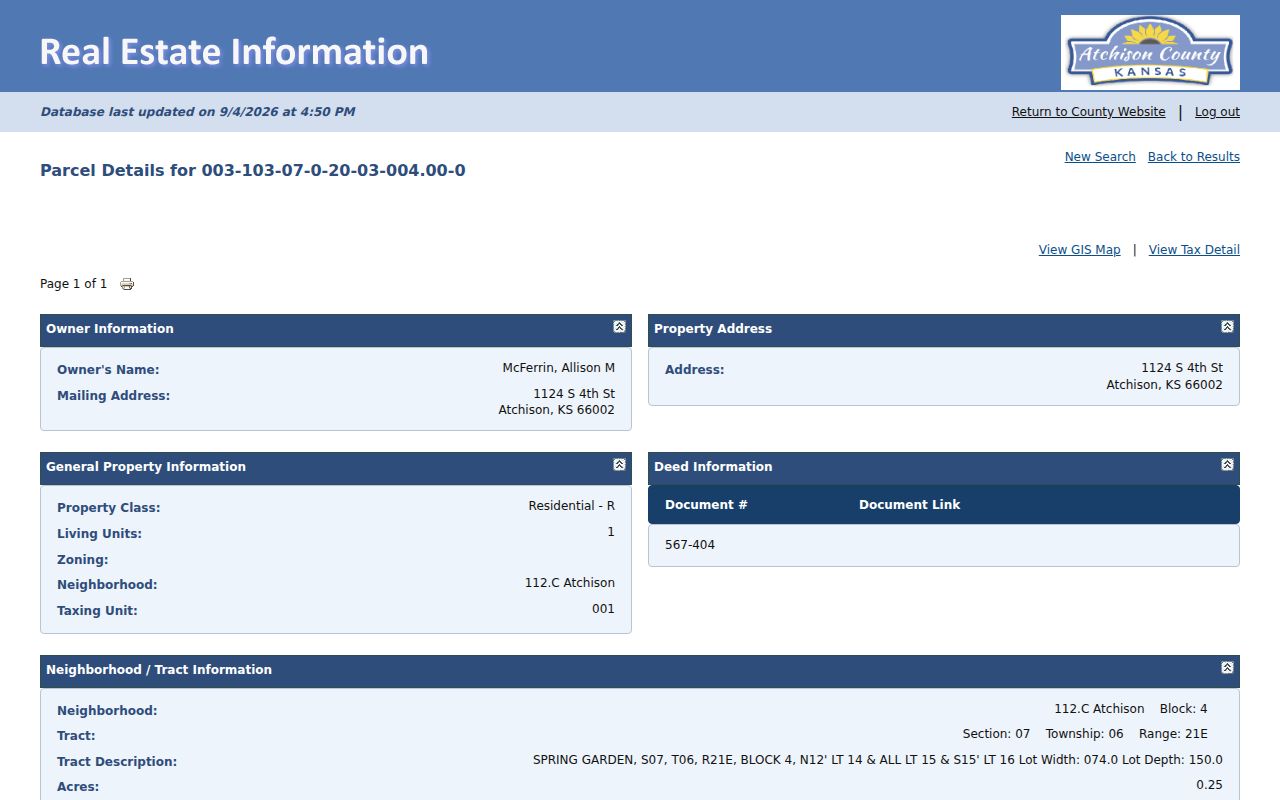
The surrounding fields explain the total. Compare property characteristics, not just the number, before drawing any conclusion about value.
Apply Kansas Class Rates to Atchison County Values
Kansas law separates appraised from assessed value. Under K.S.A. 79-1439, residential real property is assessed at 11.5 percent. Commercial and industrial property carries 25 percent. Vacant lots sit at 12 percent. Agricultural land is assessed at 30 percent of agricultural-use value, and other statutory classes follow their own treatment. Multiply correctly. A residential appraised amount and its assessed amount will therefore differ, and the assessed number then feeds the tax formula even though the meaning of the value is where this discussion stops. Bills, levies, and appeals live in the Atchison County property tax records guide. Note: Verify the class and current statute before multiplying, since the residential percentage does not apply to every parcel or component.
Separate Atchison County Farm Market and Use Values
Farm valuation needs its own reading. A rural Atchison County card may list a farm homesite beside a separate agricultural-use value for qualifying acreage, and it can also carry market-oriented land information. Do not merge those rows. Combining them into one "property value" would erase the distinction Kansas draws for agricultural land. For a farm, record acreage, homesite, agricultural-use land, market land, buildings, and total on separate lines. Check section-township-range and class. That step confirms the correct parcel is open. Use value is not a sale prediction.
Date Every Atchison County Property Value
Kansas law sets the valuation date every year on January 1. That date is fixed by statute. The county portal may show newer update banners or current-year card figures, but a later refresh never rewrites the statutory valuation date. Always read the card against its own tax year.
Save a PDF or jot down the tax year, the parcel update, and the value labels before comparing figures. A jump between two cards can come from the annual valuation, new improvements, corrected property characteristics, or a change in classification. Record changes explain many shifts. So do not assume a difference is a market trend.
Find Atchison County Sale Evidence in the Deed Trail
The parcel card shows no last-sale price. It does display a deed reference, which points toward the Register of Deeds. Pull the instrument there. Check the transaction documentation. Kansas also uses a Sales Validation Questionnaire for qualifying transfers, and a state directive describes its exemptions and a five-year retention rule. A deed's stated consideration may not equal a normal open-market sale, since some transfers are gifts, family transactions, corrections, or partial interests. County approval of the one-part SVQ process does not turn that form into a public sale-price index. Keep terms, dates, and property identity together.
Compare Atchison County Values With the Right Evidence
Several records can explain the appraiser's estimate. A taxpayer can request the property record card or a cost report. Commercial valuation can involve an income report. A residential comparable-sales report may list up to five similar homes with their sale prices. Those beat unsourced asking prices.
| Evidence | What it tests | Important limit |
|---|---|---|
| Property record card / cost report | Characteristics and cost inputs | May contain blanks, allowances, or errors |
| Comparable-sales report | County-selected similar residential sales | Similarity and sale conditions still matter |
| Recent deed and SVQ context | Actual transfer and reported conditions | Not every transfer is open-market or fully public |
| Survey, photographs, repair estimate | Parcel facts or condition | Does not replace the county's posted value until changed |
Property value characteristics run wide. Living units, acreage, improvements, topography, utilities, access, parking, location, and proximity all shape the final figure. An assessment neighborhood is simply a mass-appraisal grouping. Do not treat it as a legal subdivision or a zoning district. Before concluding that two Atchison County parcels should carry the same estimate, line up their characteristics against the land and building rows on each card. Record every lookup date and source. Evidence can explain a later correction. Still, the public card stands as the official property records entry. The county itself must change it for anything else to apply.
A recent sale can strengthen your case without dictating the next assessed value. Check that the deed covers the entire parcel. Confirm the sale was exposed to the open market. Watch for unusual financing, personal property, related parties, or a partial interest. Any of these can skew the comparison. Damage, repairs, remodeling, an acreage change, or an inaccurate improvement description can shift value too. Anchor every fact to its deed, card, report, photograph, or estimate. That keeps the reason for a difference visible.
For broader context, the Kansas Department of Revenue publishes county ratio-study reports. These include appraisal-level, coefficient-of-dispersion, and price-related-differential measures. Such countywide statistics gauge mass-appraisal performance across the tax roll. They do not estimate what one Atchison County parcel will sell for. Use them as background on the system. Never treat them as a substitute for the subject card and comparable evidence in the property records.
Know What Atchison County Property Value Cannot Prove
Mass appraisal drives the county's numbers. Atchison County weighs the cost, sales comparison, and income approaches as each applies, and the resulting value exists for tax administration. That means a record value cannot track every condition issue, private term, repair, easement question, or buyer preference in real time. A GIS map shape proves nothing about the surveyed extent of what was valued either.
Owners have a right to more detail. The county valuation guide allows a request for a property record card or cost report, and, where applicable, a residential comparable-sales report listing up to five similar homes with sale prices. Those materials from the assessor illuminate the estimate. They are still not a private, parcel-specific appraisal.
Value is not price. An Atchison County assessed value supports taxation and is not what the property must sell for. Obtain qualified appraisal and title advice when the decision requires them.